 BC LS Retail Tips
Multi-Company Replication: Head Office, Franchisees, and Who Owns the Data
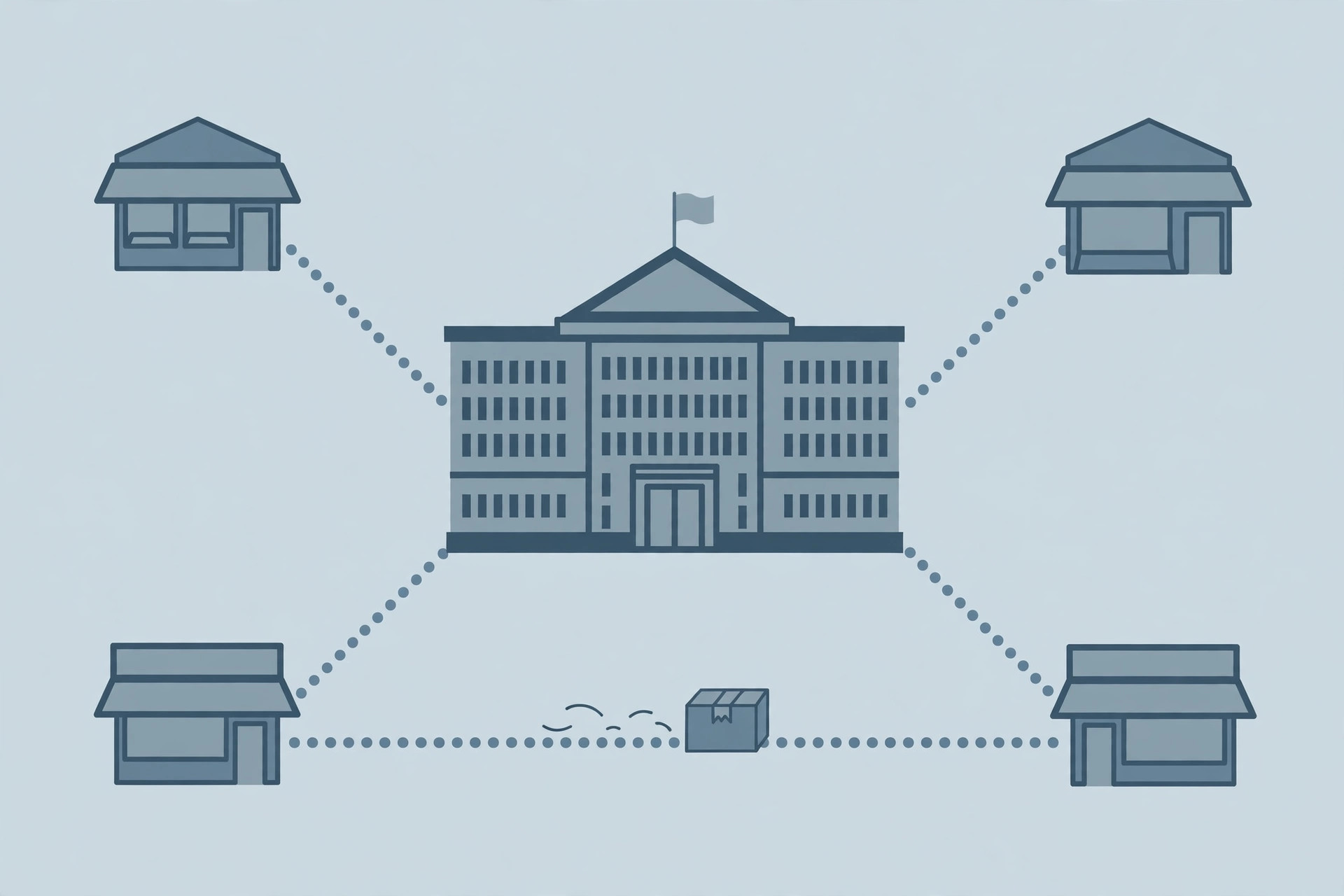
Three questions decide a multi-company setup before any replication job is configured: which company is the one writer of master data, which topology moves the goods. HQ-driven or store-driven, and what document a cross-company movement creates. Get those three answers wrong and the replication still runs; it just runs an ownership model nobody chose. This teardown works through the documented LS Central patterns and ends with the checklist to settle first.
The teardown: replication is the easy part, ownership is the design
Replication is a transport decision: which mechanism, which direction, which schedule. Ownership is the decision underneath it: who is allowed to create and change the records being transported. The documented multi-company material is replenishment material, topologies, calculations, document types, but every page of it rests on an ownership line. Purchase replenishment sits in one company. Stores sit in others. Master data sits in a designated company. The lines were drawn first; the replication follows them.
Franchise estates make the point sharply. Running replenishment across multiple companies is common in international operations and for retailers with franchise partners, settings where the companies are not just technical partitions but separate businesses. In that setting, a replication job that moves the wrong record in the wrong direction is not a sync error. It is one business overwriting another’s data.
The Master Company pattern: one writer for master data
For companies in the same SaaS environment, the documented pattern is to designate a Master Company: master data is inserted and maintained there, then replicated to the other companies. One writer. Every other company receives.
The mechanism named for that pattern is company-to-company Web Replication in LS Central 26, which reduces web calls by replicating between technically different tables in the same database. The point-to-point form of Web Replication covers the other shape: it is best suited to replicating between different environments, same tenant or across tenants, for example one master-data environment feeding regional environments.
What the pattern settles is the argument every multi-company estate eventually has: when two companies hold different versions of the same master record, the Master Company’s version is the answer by design, not by whoever replicated last. What it does not settle, because the retrieved sources do not cover it, is the governance around the pattern: what a receiving company may edit locally, and what happens to the data when a franchisee leaves. Those are decisions for the checklist at the end, stated as decisions, not as documented system behaviour.
HQ-driven vs store-driven: who calculates, who decides
| HQ-driven | Store-driven | |
|---|---|---|
| Where purchase replenishment runs | In a central supply chain company (HQ), while stores reside in sales companies | HQ handles purchase replenishment |
| Who controls store replenishment | Replenishment Item Quantity is calculated in each sales company, then calculated in the supply chain company using the pre-calculated data copied from the sales companies | The store is in full control of store replenishment |
| Does HQ calculate store proposals? | HQ calculates centrally, using the sales companies’ pre-calculated data | No, the HQ does not calculate proposals to replenish the stores |
Read the table as an ownership split, not a feature list. HQ-driven keeps the purchasing decision at the centre and pulls the sales companies’ pre-calculated quantities up to make it. Store-driven keeps the store replenishment decision at the store and limits HQ to purchase replenishment. The replication each topology needs follows from who calculates what, data flows toward the decision-maker.
Crossing the company line: sales orders, not transfer orders
One mechanism changes the moment goods cross a company boundary: because items are transferred between two companies, the system creates Sales Orders instead of Transfer Orders. A movement that would be an internal transfer inside one company becomes a sale between two.
That single substitution carries the intercompany weight of the whole model. A sales document is a transaction between parties, with a seller and a buyer, the document shape matches the legal shape of a franchisor supplying a franchisee. Planning that expects transfer-order behaviour from a cross-company movement will misread every one of those movements.
The small setup rule underneath it: location names must be in sync between the companies. The HQ-driven calculation copies pre-calculated data from the sales companies into the supply chain company; locations are how that data lines up. Two companies naming the same location differently is not a cosmetic inconsistency, it is the join key failing.
What franchisees own, and what must never flow back up as master data
The documented half of the split is clear. Master data belongs to the Master Company. Transactions belong to the company that made them: stores reside in sales companies, and the replenishment data a sales company produces, its pre-calculated Replenishment Item Quantities, is its own working data, copied up for a calculation, not surrendered.
The other half is a decision the sources leave open, and it should be made deliberately: which locally created records, if any, a franchisee company may treat as its own master data, and the rule that operational data flowing up for reporting or calculation never gets promoted into master data on the way. The Master Company pattern only protects the estate while there is exactly one writer. A second writer created by an unexamined upload is still a second writer.
The ownership checklist to settle before configuring a single job
- Name the Master Company. One company where master data is inserted and maintained, replicated to the others. If this cannot be named, stop, the replication design has no anchor.
- Pick the topology per replenishment flow. HQ-driven if purchase replenishment and store proposals are calculated centrally from sales-company data; store-driven if each store controls its own replenishment and HQ handles purchasing only.
- Choose the replication mechanism by environment shape. Company-to-company Web Replication for companies in the same database; point-to-point Web Replication between different environments, same tenant or across tenants.
- Sync location names across companies before the first calculation. Verify the names match company to company; the cross-company calculation depends on it.
- Plan documents as Sales Orders between companies. Cross-company movement creates Sales Orders instead of Transfer Orders, set up and report on that basis from the start.
- Write down the open governance decisions. Local edit rights in receiving companies, and data handling if a franchisee exits, are not covered by the documented patterns, record the estate’s own ruling on each before go-live, while it is still a choice rather than a dispute.
What success looks like: every master record in every company traces back to the Master Company, location names match across companies, a cross-company movement produces a Sales Order, and each replenishment flow runs under the topology chosen for it. When those four hold, the replication jobs are doing transport. The design underneath them is ownership, settled first, on purpose.
, Dex Carter, Tech Writer
Keep readingNext: How customer and member data moves between LS Central and Business Central →