 BC LS Retail Tips
Warehouse Receiving vs Store Receiving: Splitting the Work by Shipment Type
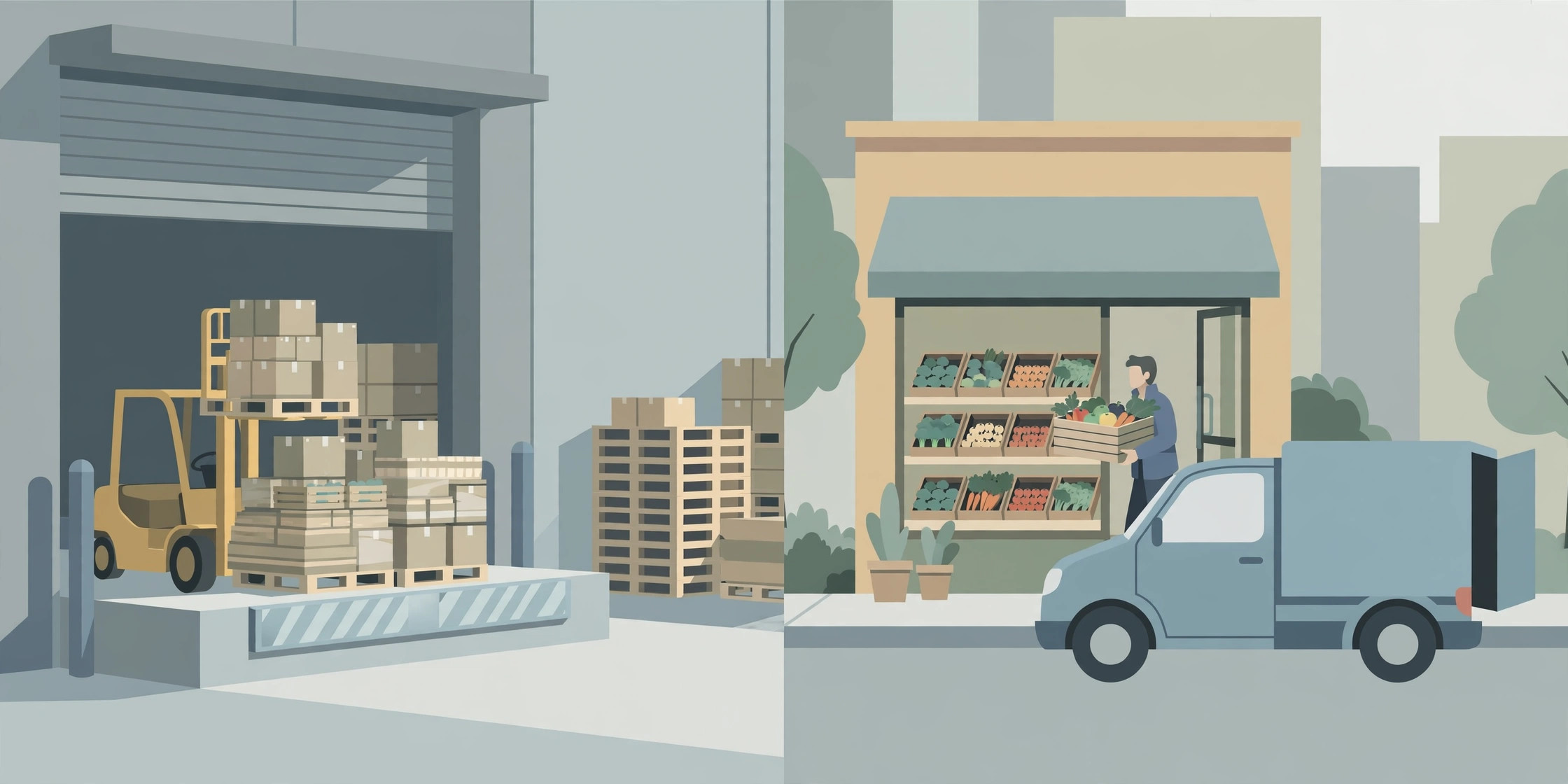
Two deliveries can arrive at the same chain on the same morning and need opposite handling. One is a palletised bulk order: many lines, quantities worth counting twice, stock that must be put away before it can be picked for several stores. The other is a supplier van with fresh product that should be on a store shelf within the hour, unloaded and faced up by the driver who brought it. Route the first to a store back room and the checking collapses under time pressure. Route the second through a warehouse and its freshness, the entire point of it, is spent in transit and storage. Receiving is not one job. It is two, and the operational skill is deciding, shipment by shipment, which job a delivery is.
Two receiving lines, two different jobs
| Warehouse receiving | Store receiving (direct store delivery) | |
|---|---|---|
| Flow | Goods arrive centrally, are received and put away, then move on to stores | Supplier prepares and loads the order and transports it directly to the store, bypassing warehousing; stock goes promptly to shelves |
| Core work | Checking, counting, and putaway, the structured start every later warehouse activity depends on | Speed and exceptions: unload, shelf, handle what is wrong or expired on the spot |
| Who handles the goods | The chain's own warehouse team | The supplier's delivery personnel unload, stock the shelves, and manage inventory at the store |
| Returns and expired product | Handled through the chain's internal processes | Delivery personnel handle returns or expired products during the visit, keeping fresh stock on the shelf |
| Cost shape | Storage and handling costs, in exchange for control and consolidation | Bypassing the warehouse reduces storage costs and touchpoints and shortens delivery time |
Direct store delivery (DSD) also changes who owns the product longest. Under DSD, suppliers maintain control of their products until they reach the retail shelves, which gives them faster demand response and sales-trend data from stores. That is a real benefit and a real trade: the chain sees less of the goods before they are already on sale.
What the warehouse does better: bulk, checking, and putaway
Warehouse training material states the principle plainly: receiving is the setup for all other warehousing activities, if merchandise is not received properly, put-away, storage, picking, and shipping all suffer. That is the warehouse's case in one line. Central receiving is where a chain can afford to check properly: full counts against the order, damage inspection, lot and date capture, and a putaway decision that determines how findable the stock is for every pick that follows.
Bulk is the natural fit. A large consolidated shipment carries enough lines and enough value that a discrepancy caught centrally is cheap, while the same discrepancy split across store deliveries is discovered late, store by store, after the paperwork has already been accepted in several places. The warehouse also absorbs variability: a late or oversized delivery waits at a dock built for waiting, instead of blocking a store back room that was built for almost nothing. Cross-docking is the middle route worth naming, stock that touches the warehouse for checking and immediate onward movement without being stored, for shipments that need central control but not central storage.
What the store does better: fresh, fast, and supplier-serviced
DSD exists because some categories lose value in a warehouse. The model simplifies the supply chain, ensures faster restocking and fresher products, and works well for perishable goods and for large, fragile, or lightweight items. Every touchpoint removed is time a short-dated product keeps, and shelf life is the currency perishables trade in.
The service bundle matters as much as the transport. On arrival, the supplier's personnel unload, stock the shelves, manage inventory, and take returns or expired product away with them. For a store team, that is receiving labour, shelf labour, and a returns channel arriving in one visit, particularly valuable in categories where the supplier knows the product's rotation and presentation better than a generalist team does. The tooling has modernised around the model: mobile devices and RFID support real-time order, inventory, and payment handling on the route, so a DSD delivery does not have to mean a paper trail that head office reconciles days later.
Direct shipping has a second, older use case beyond fresh food. Warehouse practice material notes that vendors bypassing the warehouse entirely eliminates warehouse labour, time, and equipment, and suits large bulky items, made-to-order items, and items under high consumer demand. A bulky product that would occupy warehouse space twice, once stored, once re-handled, is a routing question, not a storage question.
Route by shipment type: the split rule
The split should be a rule applied before dispatch, not a habit applied after arrival. Work through the shipment in this order:
- Is it perishable or freshness-led? If shelf life is the constraint, route direct to store. Freshness spent in a warehouse cannot be bought back.
- Does the supplier service the shelf? If the vendor's personnel stock, rotate, and remove expired product, DSD carries labour the warehouse route would duplicate internally. Route direct, and hold the supplier to the service.
- Is it bulky, made-to-order, or fast-moving enough that storage adds nothing? Route direct or cross-dock. Storage is a cost with no benefit for stock that should never sit.
- Does it need full checking, counting, lot capture, or consolidation for several stores? Route to the warehouse. Checking quality is the warehouse's product; buy it where the shipment's value or complexity justifies it.
- Can the destination actually receive it? Apply the exception checks in the next section before confirming the route, a correct route to a store that cannot take the delivery is still a failed delivery.
- Record the route and the discrepancy owner on the order. Whoever receives it owns the first discrepancy report. Decide that before the truck moves, not while it waits.
What success looks like: every open order carries a deliberate route, the receiving team at the destination expected exactly that shipment type, and no delivery is re-routed at the door except through the exception process.
Exceptions that break the split (windows, docks, and claims)
Store receiving runs on constraints warehouses rarely face. Retail stores enforce receiving windows, and a missed window can turn freight away, creating a redelivery cost and an empty shelf where the product was meant to be. A DSD route is therefore also a scheduling commitment: the supplier's route plan has to hit windows that the store sets for its own staffing, not for the carrier's convenience.
Physical access is the second exception. Many stores have no loading dock, which changes the vehicle and equipment a delivery needs, liftgate-equipped trucks are the standard workaround for dockless stores. A shipment routed direct without checking access arrives as a problem the store team solves by hand, or refuses.
Claims are the third. Discrepancy ownership differs by route, so assign it by route in advance. On a warehouse receipt, the chain's own check is the evidence, and the claim against the supplier starts from a controlled count. On a DSD delivery, the goods are stocked by the supplier's personnel and the store's check may be light by design, which means shortages surface at the shelf or the next count, and the agreement with the supplier must say what evidence a claim needs and how far back it can reach. Neither arrangement is wrong. An unassigned one is.
Verify the split quarterly: cost and error rate by route
A routing rule set once will drift: suppliers change service levels, categories change shelf life, stores change windows. Once a quarter, review the split itself, not individual deliveries, on three measures per route: cost per delivery including redeliveries and internal receiving labour, discrepancy and claims rate, and expired or unsaleable product arising on that route. Then re-run the split rule against the worst performers in each column. A category whose DSD discrepancy rate has climbed past what its freshness is worth moves to the warehouse; a warehouse category whose stock keeps arriving at stores short- dated moves direct or cross-dock. The split is a standing decision with a review date, not a tradition.
, Dex Carter, Tech Writer
IndexBack to all guides →