 BC LS Retail Tips
Transfer vs Purchase: The Decision Framework for Filling a Store’s Gap
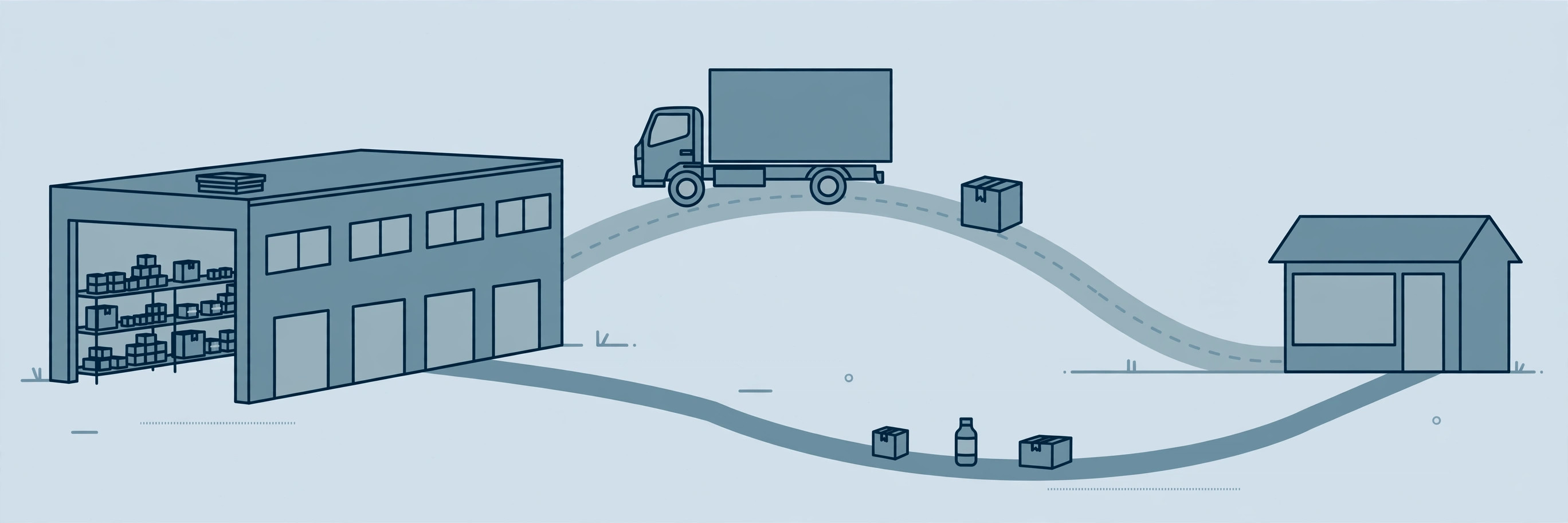
A store gap is a specific quantity of a specific item missing at a specific store, and in LS Central there are three structurally different ways to fill it. The store can buy directly from the supplier. Stock can be transferred from the central warehouse, where it already sits. Or purchasing can buy centrally and move the goods straight through to the store, the cross-docking route. Each route lands in different LS machinery, carries a different cost shape, and fails in a different way. The common shortcut, just transfer it, the stock already exists, is a claim worth checking before it hardens into policy.
Define the gap: one store short, three ways to fill it
Retail replenishment runs on two basic flows: internal transfer from the central distribution centre to stores, and purchase orders placed with external suppliers to refill the warehouse. The third route combines them: a purchase arrives centrally and a transfer order immediately carries the cross-docked quantity onward to the store that needs it.
In LS Central terms, the routes are distinct operations. Manual Replenishment is buyer-initiated, purchase orders and/or transfer orders created by a person, as opposed to Automatic Replenishment, where the calculation engine suggests them. Head office distributes warehouse stock through Allocation Plans and Buyer's Push. Stores, for their part, can create direct purchase orders, create transfer orders from warehouse to store, or raise Stock Requests that central purchasing approves or declines and then sources. So the transfer-vs-purchase question is never abstract: the answer decides which of these documents a buyer creates, and which team owns the follow-through.
The myth: transfer is always cheaper because the stock already exists
The myth has a plausible core. Stock in the warehouse is already paid for, already received, already counted. A transfer avoids a supplier lead time and a new invoice, and where one store is overstocked while another sells the same item fast, moving stock sideways feels obviously better than buying more of it.
The flaw is that "already exists" prices the stock at zero and prices the movement at zero. Neither is true. The dedicated treatment of this decision. Effective Inventory Management's "To Purchase or Transfer", frames it as a calculation, not a reflex: buyers must decide whether to buy directly from a supplier or transfer from a central warehouse, weighing the extra branch inventory created by full vendor package quantities against the cost of double handling through the distribution centre. Transfer has a real cost in that framing. Purchase has a real cost too, of a different kind. The framework later in this guide scores both.
The purchase case: pack quantities, turnover, and branch overstock
Suppliers rarely sell the exact quantity a single store is short. They sell vendor package quantities, a case, a pack, a minimum, and a direct purchase delivers the whole package to the branch. If the gap is 10 and the case is 48, the purchase fills the gap and parks 38 extra units in a store that only needed 10. Whether that overstock is acceptable is a turnover question, and the dedicated source gives the calculation:
- Set a target inventory turnover for the item at the branch, how many times a year the branch's stock of it should sell through.
- Take total annual usage of the item at that branch.
- Divide annual usage by the vendor package quantity to get the packages the branch sells per year. The worked example: 960 units of annual usage divided by a case of 48 gives 20 packages a year.
- Read the result against the target. Twenty packages a year means a full case is a short-lived quantity at that branch, direct purchase in full packs does not strand stock there. A branch that works out to two packages a year is the opposite case: each direct delivery leaves most of a case sitting while turnover targets say it should have moved.
What success looks like: the packages-per-year figure is on the table before the order is placed, and the branch's expected overstock from full packs has been compared against its target turnover, not discovered at the next stock count.
Note what the calculation does not need: a network-wide rule. The same item can be a sound direct purchase at a high-usage branch and a poor one at a low-usage branch, because annual usage sits in the numerator. The decision is per item-store, which is exactly the level the framework below scores.
The transfer case: surplus, handling twice, and time on the truck
Transfer's cost is handling. Stock bought into a central warehouse is handled once on the way in; a transfer handles it again on the way out to the store, received, stored, picked, shipped, and received a second time at branch level. That double handling through the distribution centre is the price of keeping branch stock lean: the centre absorbs the full vendor package quantities, and each store draws only what it needs.
Transfer also has a precondition the myth skips: there must be a genuine surplus to move. A transfer out of a warehouse that is itself short just relocates the gap. In LS Central the transfer route is exercised through the Transfer Replenishment Journal, which creates transfer orders to replenish stores, or sales orders where the replenishing source is another company, and manually through transfer orders and Buyer's Push from head office. Every one of those documents spends warehouse stock. Before choosing transfer, the check is not "does the system show stock?" but "does the network hold more of this item than the stores that hold it will sell?"
Time cuts both ways, and honestly: a transfer of stock already in the building can move on the next scheduled run, while a purchase waits on the supplier. But that speed is only real for stock that is genuinely surplus, a transfer promised against stock that another store's allocation already claims creates a second gap downstream.
The hybrid: purchase to the DC and cross-dock the gap
The third route dissolves the either/or. Buy centrally in the vendor's package quantities, keeping the purchasing terms and the pack economics at the centre, and transfer the needed quantity straight onward to the short store as part of the same replenishment run. LS Central supports this directly: the Purchase Replenishment Journal creates purchase orders to replenish stores and warehouses, and for cross-docking quantities it also creates a corresponding transfer order to the stores.
Cross-docking fits a specific shape of gap: the store needs the item, the warehouse does not hold surplus, and the quantity justifies a purchase, but the branch should not receive or store a full vendor pack. The purchase solves the supply problem; the immediate transfer solves the pack problem. What it does not solve is handling: cross-docked goods still pass through the centre, so the double-handling side of the ledger stays in the calculation.
The framework: score the item-store, then let the journal follow
Score each gap on four inputs, in this order, before choosing the document:
- Is there genuine network surplus? If another location or the warehouse holds more than it will sell, transfer is a live candidate. If not, transfer is fiction, the choice narrows to purchase or cross-dock.
- How does the vendor package quantity compare with the gap? Run the turnover calculation: annual usage at the branch divided by package quantity. Many packages a year points to direct purchase; a fraction of a package a year points away from it.
- What does touching the stock twice cost here? Double handling through the centre is transfer's price. It is worth paying when it prevents branch overstock that would sit past its turnover target; it is waste when the branch would have sold the full pack promptly anyway.
- Which LS route executes the decision? Direct purchase: a purchase order, raised by head office or, where stores hold that permission, by the store itself, with Stock Request as the approval route into central purchasing. Transfer: a transfer order via the Transfer Replenishment Journal, an allocation, or Buyer's Push. Hybrid: the Purchase Replenishment Journal with cross-docking quantities, which produces the purchase order and the corresponding transfer order together.
The discipline is the order of operations. Decide from surplus, pack arithmetic, and handling cost first, then let the journal follow the decision. Starting from the document, which is what "just transfer it" does, guarantees the cost test never happens.
, Dex Carter, Tech Writer
IndexBack to all guides →