 BC LS Retail Tips
Self-Checkout Profiles in LS Central: Setup, Supervision, and Shrinkage Honesty
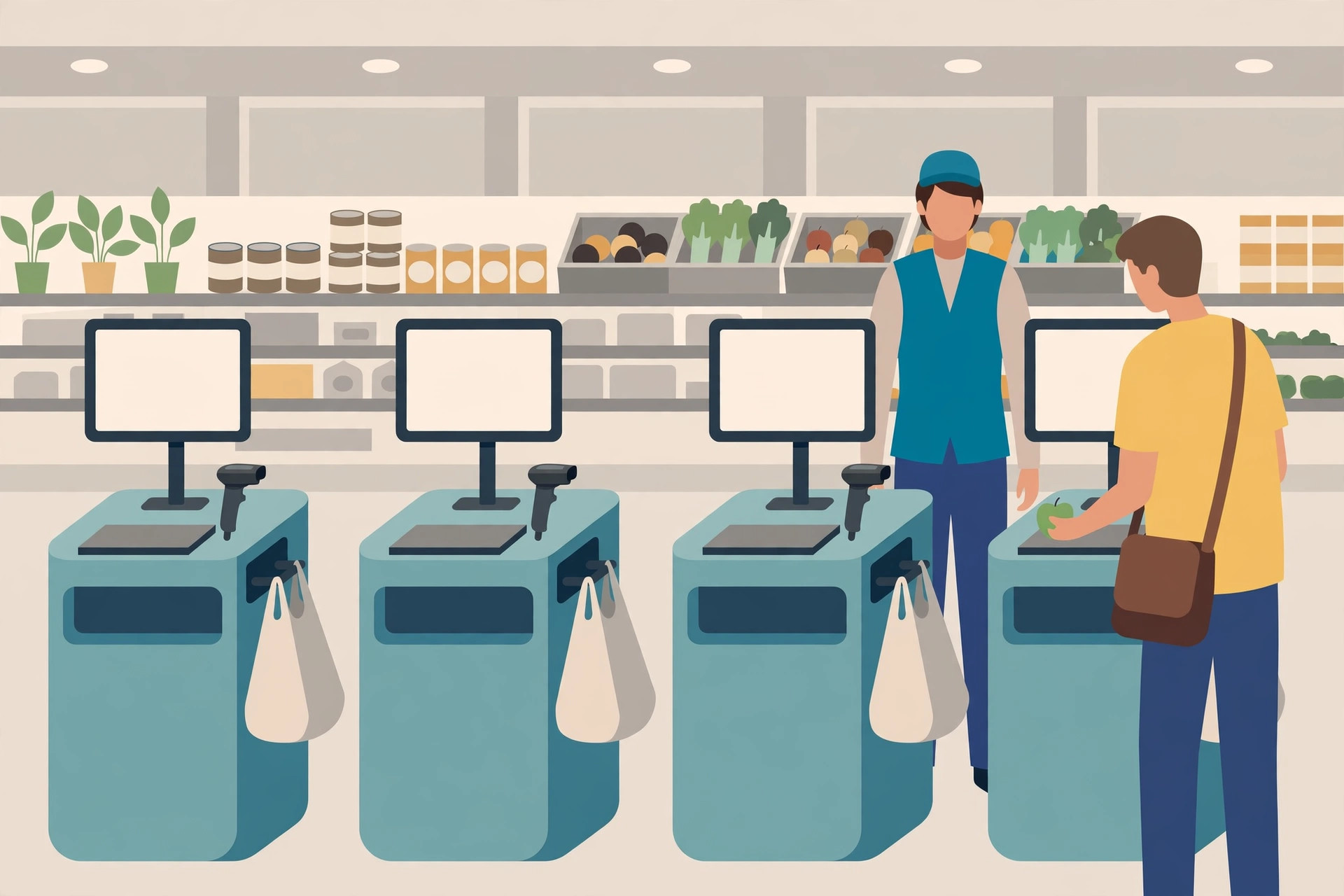
One associate can supervise multiple self-checkout stations. That single fact, from LS Retail's own self-checkout guidance, is where an honest setup starts, not with a station count, a tender list, or a shrink promise. Self-checkout in LS Central is a supervision model built on a familiar till, and the profile a store exposes to customers is only as good as the attendant coverage, intervention design, and measurement behind it.
The first question: what problem is self-checkout solving here?
A queue problem, a staffing problem, and a small-basket problem are three different deployments. A station tuned for a handful of items, with an attendant close by, behaves differently from a station expected to absorb a full weekly shop unaided. LS Retail frames self-service as choice, assisted lanes, self-checkout, and other journeys side by side, rather than as a replacement for staffed lanes. So the first setup decision is a routing decision: which baskets belong at self-checkout, and which should be directed to a staffed lane before frustration, interventions, or errors pile up?
Write that answer down before configuring anything. It determines the hardware footprint, the tenders worth offering, and how much attendant time the deployment actually needs. A pilot built around an undefined problem cannot be measured afterwards, because nobody agreed what success was supposed to change.
Same POS, new profile: what changes and what must not
Self-service should run on the same POS foundation as staffed lanes. In LS Central that brings centralised updates and configuration, shared pricing and promotions, unified reporting, and reduced training, because staff and customers are working from the same underlying system rather than two diverging ones. Pricing and promotions in particular must not drift: a self-checkout station that prices an offer differently from the staffed lane next to it creates disputes at exactly the point where no cashier is present to resolve them.
One honesty limit belongs in every plan. Field-level self-checkout profile setup is not publicly documented in the LS Retail material available for this guide, so what follows is profile design and operating decisions, which functions to expose, which to lock, which tenders to allow, not invented screen-by-screen steps. Treat any guide that names precise profile fields without a source with suspicion.
Two connector details are documented, and both matter. A hotfix for LS Central 27.1 adds a web service enabling Suspend Transactions in the Self Checkout Connector, relevant if an interrupted self-checkout basket needs to be picked up rather than abandoned. The same hotfix line also corrected self-service kiosk deal lines being left incorrectly inserted when an ingredient was out of stock. Check the hotfix level before relying on either behaviour.
Tenders, restricted items, and intervention design
Hardware can stay modular. LS Retail's guidance covers cashless stations and simplified non-grocery setups built from a screen, a scanner, and a printer, with adaptable designs by store type; some IKEA stores, it notes, use standard computers, scanners, and printers. Cashless is therefore a legitimate starting configuration, not a cut-down compromise, but it is a policy choice. A cashless-only profile excludes cash customers by design, so decide that openly rather than discovering it in complaints.
Interventions need the same deliberate design. Security-check messages at self-service stations are configurable in LS Central, and partners can extend them. One limit is worth stating plainly: the basic functionality does not classify individual customers when deciding security checks. Checks are therefore station and transaction events, not customer profiling, write staff guidance that matches that reality, so attendants respond to a check message as a prompt to help, not as an accusation to deliver.
For produce and high-risk items, LS Retail lists AI-assisted recognition among its shrink controls. That supports routing awkward items through recognition and attendant confirmation instead of pretending a profile setting makes them risk-free. Categories a store decides are unsuitable for unattended scanning belong on the staffed-lane routing list from the first section.
Setup procedure: from pilot decision to live station
- Name the problem and the basket. State which queue or basket type the pilot targets, and which baskets route to a staffed lane instead.
- Confirm the foundation. Verify the station will run on the same LS Central POS foundation as staffed lanes, so pricing, promotions, configuration updates, and reporting stay shared.
- Choose the hardware footprint. Pick a modular layout that fits the store type, for a simplified non-grocery setup, a screen, scanner, and printer may be the whole station.
- Decide tenders explicitly. Record whether the profile is cashless or also handles cash, and treat that as a customer-access decision, not a default.
- Configure the security-check messages. Set the messages a customer sees when a check triggers, in plain language, and note where a partner extension would be needed for anything beyond the basic functionality.
- Check the hotfix level. If the design relies on suspending a self-checkout transaction through the connector, confirm the 27.1 hotfix that adds that web service is applied.
- Staff the supervision model. Assign dedicated attendants to the stations for the pilot, define what an intervention is, and start the intervention log on day one.
- Measure the baseline first. Record shrink and queue measures for the affected area before the stations go live, using the routine in the next section.
What success looks like: a customer can complete the target basket without staff rescuing routine steps, every security check produces a calm attendant response rather than a confrontation, prices and promotions match the staffed lane exactly, and the store can compare its after-pilot numbers against a baseline it actually recorded.
The supervision model: attendants, alerts, and escalation
LS Retail's shrink best practices start with dedicated attendants, then layer technology around them: integrated cameras, weight verification and smart scales, RFID identification, AI-assisted recognition for produce and high-risk items, image and barcode validation, and AI analytics for suspicious patterns. Read that list in order. The attendant is the control; the rest are aids that make one attendant effective across multiple stations.
That is also the staffing dividend, stated accurately: one associate can supervise multiple stations while other staff redeploy to service roles. It is not a promise that self-checkout needs no staff. A deployment that budgets zero attendant time has removed the first control on the vendor's own list, and should expect the shrink discussion later to go badly.
Escalation design is simple to state and easy to skip. An attendant handles routine checks. A transaction that cannot be resolved at the station moves, to a staffed lane, or to a suspended transaction where the connector support is in place, rather than trapping the customer at a flashing screen. Every escalation is an intervention worth logging, because the log is what turns anecdotes about "constant problems" into a count a manager can act on.
Shrinkage honesty: baseline first, then measure
The most useful sentence in the source material is the implicit one: modern self-checkout manages shrink rather than eliminating it, through oversight plus intelligence. Any business case that assumes shrink falls to zero, or falls by a vendor-supplied percentage, is fiction. The store's own number is the only one that counts, and it has to be measured, not quoted.
A workable measurement routine, a proposal for the store, not a vendor feature, has three parts. First, a baseline: record the shrink figure for the pilot area before launch, over a period long enough to be comparable. Second, basket audits: sample completed self-checkout baskets and compare contents against the transaction, so errors and missed scans show up as a rate, not a rumour. Third, the intervention log from the setup procedure: how often attendants intervened, and for what. Together those three show whether shrink moved, where it moved, and whether supervision, not luck, is what is holding it in place.
Decide: pilot store, success numbers, and the stop rule
| Question | Pilot-ready answer | Stop signal |
|---|---|---|
| Problem | A named queue or basket problem, with routing rules to staffed lanes | "Fewer tills" with no basket definition |
| Supervision | Dedicated attendant coverage for the pilot hours, interventions logged | No attendant budgeted; technology expected to do it alone |
| Tenders | Cashless or cash decided explicitly, with the customer impact accepted | Tender policy discovered after installation |
| Shrink | Baseline recorded before launch; audits and logs running from day one | No baseline, any later shrink claim is unverifiable |
| Foundation | Same POS foundation, hotfix level checked for connector behaviour relied on | Separate pricing or promotions on the self-checkout profile |
Bottom line: pilot in one store, with an attendant, a baseline, and a stop rule agreed before the stations arrive. Self-checkout on a shared POS foundation is a modest configuration project. Self-checkout without supervision and measurement is an unpriced shrink experiment.
, Dex Carter, Tech Writer
IndexBack to all guides →