 BC LS Retail Tips
Quick service vs table service in LS Hospitality: what the service type actually changes
Two outlets, one system, opposite rhythms: the counter wants an order paid and fired to the kitchen in under a minute; the dining room wants an order that stays open for two hours and grows by courses. In LS Hospitality that difference is not training or habit, it is the Service Type field on the hospitality type. Selecting a service type applies a bundle of default settings, and that bundle quietly decides how an order is identified, what the POS screen is organised around, and how the order reaches the kitchen. This article compares the two profiles behaviour by behaviour. (Whether to run hospitality or retail mode at all is a different question, covered in the hospitality-vs-retail profile guide; this one stays inside hospitality.)
The service type is a bundle of defaults
The Service Type field indicates the service type of the hospitality type, and when you select one, default settings are applied. The full family is: Not Specified (no specific service type, no settings set), Dining Table Service, Quick Service, Open Orders, Takeout Service, and Self Service. The two profiles this article compares anchor the family; the others are variations worth knowing exist. Open Orders keeps an order open to be added to without a table, Takeout runs on the KOT list with payment on pick-up or on ordering, and Self Service behaves like normal retail. Two settings barely differ across the family: After Transaction Posted is Return to Startup POS, and Sales POS Opening Mode is Sales. Almost everything else that matters does differ.
Side by side: what differs in service
| Dining Table Service | Quick Service | |
|---|---|---|
| The guest pattern | Guests sit down at a dining table; orders are taken for the table | Guests order and pay directly; ordered items may be sent to the kitchen for preparation |
| Layout View | Graphical Dining Tables or Dining Table Grid, requires a dining area profile containing the dining table setup and layout | KOT List (kitchen order tickets) |
| Order ID | By Dining Table ID | Queue Counter, Manual Input by Sales Type, or Receipt No. Only |
| Payment timing | At the end of the meal, against the table's open order | Up front, as part of the order flow itself |
| Kitchen relationship | Courses sent as the meal progresses, by menu type or send method per type | Whole order sent to KDS on paying, or item by item as added |
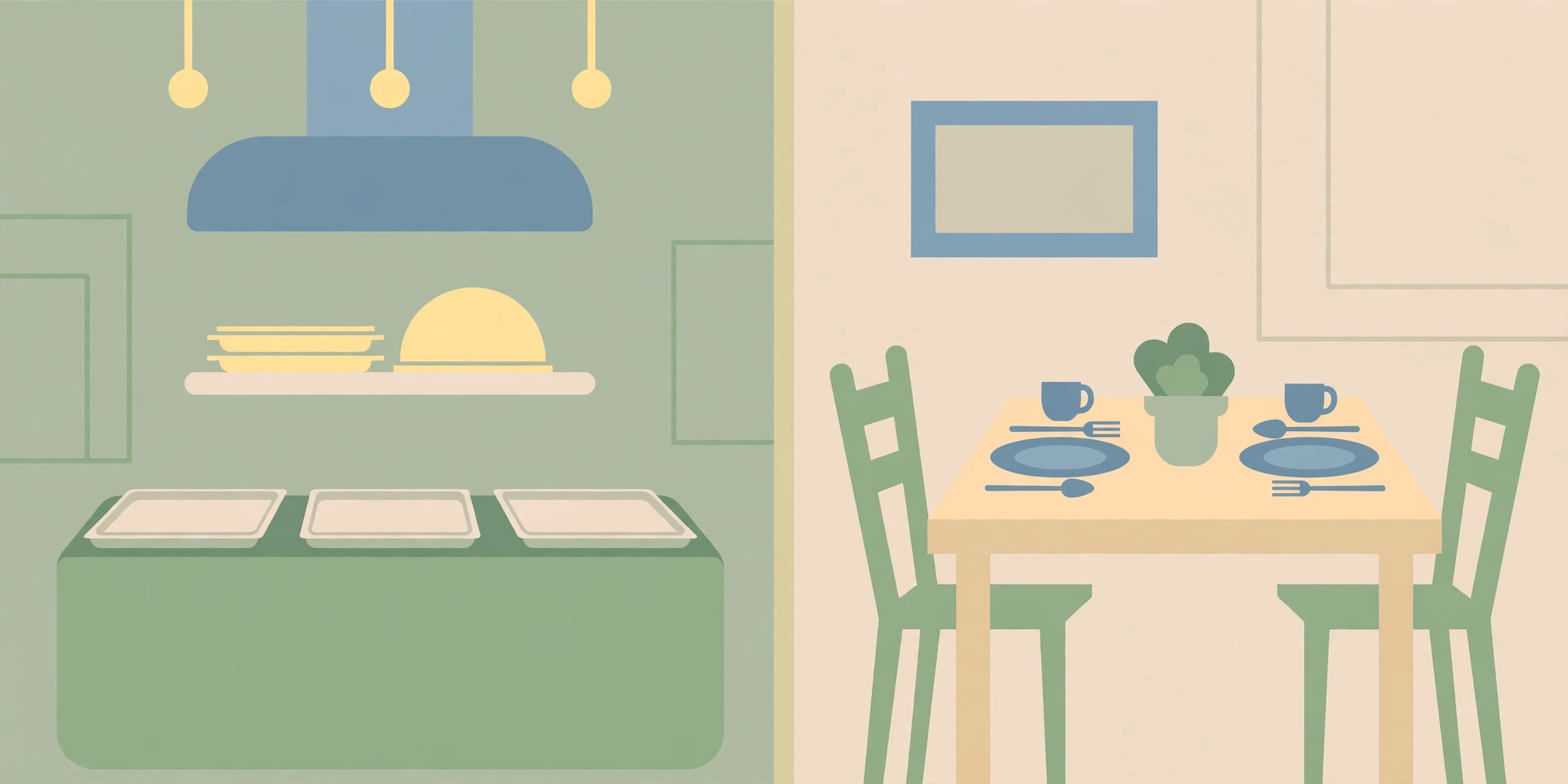
Read the table as two organising ideas. Table service organises the POS around a place: the table exists before the order, outlives any single course, and is the key everything hangs from. Quick service organises the POS around a ticket: the KOT list is the work queue, and the order's identity is a counter number a guest listens for. Every downstream behaviour, including what confuses staff who rotate between outlets, follows from that one difference.
Order identity: table ID vs queue counter
Under Dining Table Service, the Order ID is the Dining Table ID. The order is found by where the guests are; covers, courses, and splits all attach to the table. Under Quick Service, the Order ID is the Queue Counter, Manual Input by Sales Type, or Receipt No. Only, identities designed for a flow where the guest and the order separate immediately after payment. Quick service also lets you have a queue counter and request a description for the sales type, which is the counter's version of a name on the order. Neither identity is a setting you can borrow from the other profile: a dining room asking for queue numbers has a service-type problem, not a training problem. One refinement belongs to the terminal, not the type: on specific POS terminals, a dining table service can present its tables as a Dining Table List view, that view is set for the POS terminal, not the hospitality type.
Payment timing and the kitchen: two clocks
Quick service's defining flow, as documented for its KDS integration, runs on the payment clock. Items are sent to the KDS in one of two ways: automatically on paying, or automatically when they are added to the order. In the on-paying flow, the staff create the order, add items, and press Total (or a tender type); the system sends the items configured for KDS; one order is one KOT; items display on the kitchen displays ordered by production time. When the customer pays, the order's payment status on the KDS stations changes to Paid; item lines are bumped on the preparation stations, the KOT is bumped on the expeditor stations, and the customer display shows the order when it is completed. Payment, production, and pickup are one continuous motion.
Table service runs on the meal's clock instead. The order opens with the seating, grows course by course, and is paid at the end, so its kitchen sending is governed by the hospitality type's send method across a long-lived order, not by a single payment event. That is also why the two profiles stress different failure points: quick service breaks at the counter (identity and payment), table service breaks at the table (an open order nobody owns, a course never sent).
Running both profiles in one estate
Nothing forces an estate to choose one profile globally, hospitality types are per outlet, and the counter and the dining room can run different service types in the same restaurant group. What must stay deliberate is everything the profiles do not share. Layout views differ (table layout vs KOT list), order IDs differ, and, the subtle one. KDS send timing is configured per hospitality type on its KDS FastTab. If the dining room's type sends items as they are added (same KOT, chronological order) while the counter's flow builds orders that display in production-time order, shared display stations can end up showing a mixture of both orderings. The documented remedy is separation: let the types use different display stations and route items accordingly, rather than training the kitchen to read two orderings on one screen.
Choosing per outlet: a decision framework
- If guests pay before they eat and leave with the order, then Quick Service, its identity, KOT list, and pay-first kitchen flow are built for exactly that motion.
- If guests sit, order in stages, and pay at the end, then Dining Table Service, and accept its prerequisite: a dining area profile with the table setup and layout.
- If the order must stay open without a table (a bar tab pattern, a phone order being built), then look at Open Orders before bending either main profile out of shape.
- If the outlet is takeout-first, then Takeout Service runs the same KOT list with payment on pick-up or on ordering, closer to the counter than to the dining room.
- If staff rotate between outlets, then train the identity difference explicitly: find the order by table here, by queue number there. Most “system confusion” between outlets is this one difference surfacing.
FAQ
Can one restaurant run both quick service and table service?
Yes, the service type lives on the hospitality type, so outlets can differ. Keep their
layout views, order IDs, and KDS send behaviour deliberate, and give their kitchen traffic
separate display stations if their send methods would mix orderings on one screen.
Why does my quick service POS ask for a table?
It should not, a table prompt means the hospitality type is running a dining table service
type (or Not Specified with table-oriented settings). Check the Service Type on the
hospitality type; selecting Quick Service applies the KOT-list, queue-counter defaults.
Does quick service skip the kitchen display?
No. Ordered items may be sent to the kitchen for preparation, and the documented quick
service flow sends them to KDS on paying or as they are added, with payment status and
completion flowing back to the POS and the customer display.