 BC LS Retail Tips
LS Central POS offline mode: what happens and what to check
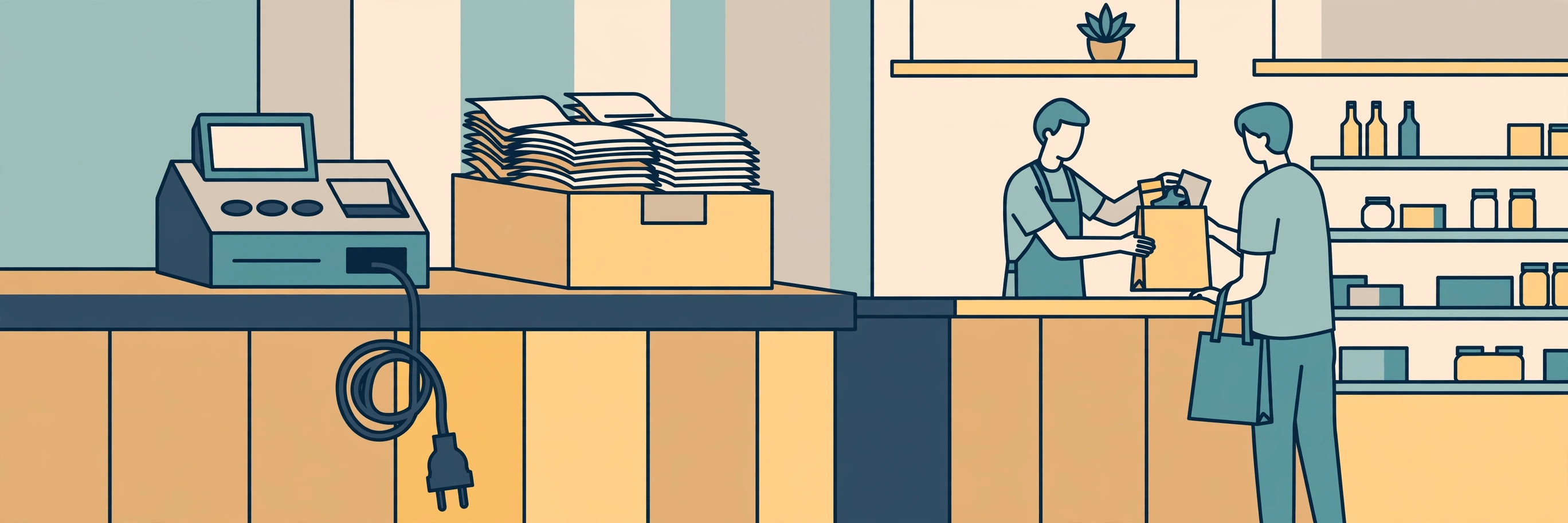
A lost connection does not produce one LS Central behaviour. It produces the behaviour of the deployment in front of you. LS Retail's own implementation guide for SaaS describes two different ways to run an offline POS, and neither of them is the same thing as an online terminal that has simply lost its link to a cloud service tier. Before you predict what a till did during an outage, name which setup it is running.
Start with the deployment, not the outage
For head office in SaaS, LS Retail documents two offline POS options in its Offline POS Model guide: Web Replication using Azure Storage, which LS Retail recommends, and the Hybrid Component Server (HCS), which it offered in earlier LS Central versions. Web Replication using Azure Storage arrived in LS Central version 24.0. The HCS route is a collection of tools, including Data Director and Update Service, plus a template database called POSMaster.
Within those models, where the database sits changes what an outage means. LS Retail's simplified offline POS model describes two store layouts:
- Offline POS database, on the terminal itself. The POS runs the SQL database, the service tier, Data Director, and the Business Central client locally. LS Retail describes these POSs as resilient and says they do not need a network to operate. A head office link dropping is exactly the case this layout is built for.
- Offline POS server database, on a store server. The database and service tier sit on a POS server in the store, and the terminals only run the client and connect to that server through the web client. LS Retail states that these POSs rely on the store LAN working and on always having access to the store server. So for this layout, losing the internet and losing the store server are two different failures: the first may leave trading untouched, the second takes the terminals' database away.
An online POS is a third case. LS Retail's data replication guide treats transaction replication as something required only for the offline POS architecture, because the online POS is connected directly to SaaS using a web browser. Do not assume an online terminal gained a local queue the moment its connection dropped. Offline trading is an architecture that was set up in advance, not a fallback every terminal carries.
The Mobile POS is a fourth case, with its own documented behaviour, covered separately below. Do not read its rules across to the desktop POS, or the other way round.
What an offline POS is working from
In the Azure Storage model, LS Retail documents that the Scheduler runs in head office in SaaS and Web Replication using Azure Storage is used to push master and setup data updates to the offline POS. The flow runs the other way as a pull at the store end: the offline POS, or the offline POS server, calls head office to ask whether packages are waiting, and then pulls those packages down from Azure Storage.
That mechanism is the honest version of the stale data warning. The POS sells from the master and setup data it has actually received. A price, item, or setup change made at head office after the last package the POS pulled is not in the local data yet, because nothing in the documented flow pushes it there in real time. If a price changed at head office during an outage, check when the POS last pulled a package before you argue about which price was right.
Some functions are documented as online requirements rather than local ones. The same LS Retail model pages list web services as the route used for online requirements, naming inventory lookup and voucher validation as examples. Treat any function of that kind as unavailable to assume during an outage: if it needed a web service call, the call has nowhere to go. What your own POS does with such a function when the call fails is a question for your configuration and your partner, not something the model pages promise.
One limit is worth stating plainly, because the original version of this article did not. The official offline POS model pages consulted for this rewrite do not list which tenders, returns, or discount types keep working on a desktop offline POS. So this article does not claim that card tenders, returns, or any specific discount behaviour survive an outage on that layout. The only documented offline discount and payment behaviour found is for the Mobile POS, in the next section. If your store's trading rules depend on a tender or a return working offline, get that confirmed for your own setup and version, in writing, before an outage tests it for you.
Mobile POS: the documented offline behaviour
LS Retail's Offline Functionality page for the Mobile POS is specific, and it applies to the Mobile POS only. It states that the offline functionality makes it possible to make a payment without an internet connection, that you can sell items and post transactions offline, and that you can add manual discounts in offline mode. When the Mobile POS is offline, a banner at the bottom of the screen shows the Wi-Fi signal, and buttons that rely on an internet connection are disabled.
When the connection is restored, LS Retail documents that the banner disappears, the app checks for offline transactions every minute, and those transactions are automatically uploaded to LS Central. There is also a manual route: on the Home screen, tap Functions, then tap Offline transactions, then tap Post transactions at the bottom of the screen to post all the offline transactions.
When the connection comes back: check the route your model uses
There is no single upload mechanism to check, because the models move transactions differently. Work through the checks that match your deployment:
- Name the mechanism first. In the simplified Azure Storage model, LS Retail's dataflow has sales transactions pushed from POS servers to head office after each sale using POS web services. LS Retail's replication guide describes an alternative for extended transaction tables: Web Replication as a background session, switched on in the POS Functionality Profile by activating Send Transactions, Use Background Session, and Use Web Replication. The version 26 help page on sending transactions using Web Replication covers the Use Background Session and Use Web Replication settings on the POS Functionality Profile card. The replication guide also notes that LS Central version 26.1 added a further option, Send Transactions by Storage Queue, for large numbers of offline terminals. An HCS and Data Director installation moves data by yet another route. Checking the wrong queue tells you nothing.
- Confirm the transactions arrived centrally. Check that the offline period's transactions are present in the transaction list in LS Central, and compare counts against the POS report for the same period. A till that traded is not evidence that head office received anything. This comparison is a verification step, and it is the step that catches a queue that only partly drained.
- Check the replication and scheduler state for your model. An outage can leave a failed job behind it. For the Azure Storage model, LS Retail documents example scheduler jobs named OFFLINE_POS_INIT, OFFLINE_POS_UPDATE, and WEBREPLICATION, with entries created in the Web Replication Request Queue for the WEBREPLICATION job to process. For a Data Director installation, check the Data Director jobs instead. Confirm the mechanism is running cleanly again, not just that the network is back.
- Review anything that changed centrally while the terminal was offline. Price updates or item changes made at head office during the outage belong to packages the POS had not pulled yet. Review the uploaded transactions against those changes before statement calculation. Treat this as a check to run, not as a documented guarantee that a mismatch will be flagged for you.
- Use the missing transactions check where your version has it. LS Retail's help describes a Check for Missing Transactions field in the Functionality Profile: when the statement is calculated, the system compares the highest transaction number in the local database against the highest transaction number in the POS terminal's database, and if transactions are missing, a page shows which terminals are affected and offers the chance to abort the calculation. That description comes from the LS Central 11 help page on checking transactions in statement calculation, and the page notes it applies only when the store's closing method is by POS terminals. Confirm the equivalent setting in your own version's documentation before relying on it.
- Then run the normal close. Only calculate the statement once the transaction list is complete. (See our end-of-day routine.)
How a silent gap shows up later
The version of this problem that costs time is the quiet one: a terminal was offline and came back without anyone noticing, and not everything it recorded reached head office. The later symptom to investigate is statement totals that do not match the POS report, or transactions that appear to be missing. Those symptoms have other causes too, so treat them as a prompt, not a diagnosis. But before you assume a posting problem, ask the prior question: was any terminal offline today, and if so, which model is it, and did its transactions arrive?
Before the next outage
- Write down each terminal's model. One line per terminal in the store's own notes: offline POS database, offline POS server database, online POS, or Mobile POS, plus the mechanism it uses to send transactions. That line is what turns an outage from an argument into a checklist.
- Check version compatibility deliberately. LS Retail states that offline POS backwards compatibility is currently supported for three major versions for 18 months, that compatibility is intended for a head office version greater than the POS version, and that in LS Central version 26, offline POS communication with head office is tested back to version 23. A head office upgrade is therefore also an offline POS compatibility check, not just a head office event.
- Monitor connectivity in some form. Even a simple ping check per terminal beats finding out from the cashier. This is a suggestion, not an LS Retail requirement, and it only helps if someone acts on it.
- Train staff to report it. "The POS was offline" should reach management the same day, while the checks above can still be run against a short, known window. That is store practice, not product behaviour, and it is the part head office cannot automate for you.
Decision rule to close on: if a terminal traded while disconnected and its transactions are not confirmed in head office, the statement is not ready, whatever the till report says. Confirm arrival first, calculate second.
IndexBack to all guides →