 BC LS Retail Tips
Versioning an Integration: What Breaks When Business Central Updates Land
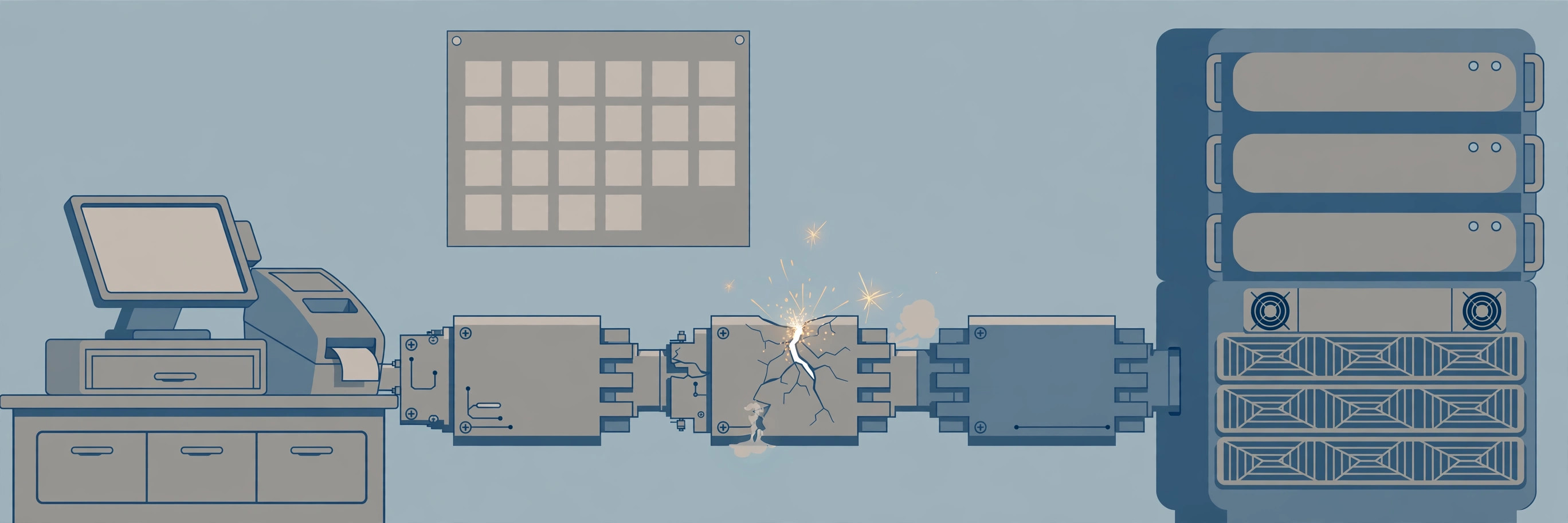
2027 is the date that turns versioning from a preference into a deadline. OData access built on UI pages stops working in 2027, in Business Central v30. An integration that calls those pages is not merely old-fashioned — it has an expiry date, and an update wave will enforce it whether the calling code changed or not. That is the pattern worth learning from: integrations rarely break because their own code moved. They break because one of the version contracts underneath them did.
The three version contracts hiding in one endpoint
A single retail integration — the feed between Business Central and a POS, an e-commerce storefront, or a warehouse tool — leans on three separate contracts at once. They version independently, they fail independently, and an update can touch any one of them while leaving the other two looking untouched.
Contract one: the API surface itself. API Pages carry version numbers, and that versioning is the point: because the version is part of the contract, updates are less likely to break integrations that call them. API Pages are built for integrations, are contract-based, and are described as more stable than UI pages exposed as OData. They also handle filters and large data faster than the UI-page route.
Contract two: the concurrency token. A PATCH update requires the If-Match header carrying the record’s etag. Code that updates prices, items, or stock records without sending a current etag is not working around the contract — it is depending on the contract never being enforced more strictly than it is today.
Contract three: the throttle. Business Central OData v4 allows 6,000 requests in a sliding 5-minute window, with a maximum of 5 concurrent requests, and returns HTTP 429 when the limits are exceeded. Integrations are expected to handle that 429 and retry with exponential backoff. A caller built for yesterday’s traffic can meet this contract for the first time on the busiest day after an update, not during testing.
| Surface | Versioned? | Stability basis | Hard limit in the packet |
|---|---|---|---|
| API Pages | Yes — version numbers are part of the design | Contract-based, built for integrations | Updates are less likely to break callers |
| UI pages exposed as OData | No equivalent version contract | Tied to pages designed for screens, not callers | Stops working in 2027 (v30) |
| OData v4 calls generally | Version in the endpoint | Throttle contract applies regardless of surface | 6,000 requests per sliding 5 minutes; 5 concurrent; HTTP 429 past the limit |
Read the table as a spec check, not a preference poll. Only one row carries a retirement date. Only one row was designed so that a caller can pin a version and expect it to hold.
What an update wave can change without touching your code
Three failure shapes follow directly from those contracts. First, a surface retirement: the OData UI-page route ends in 2027, so every caller still on it breaks on a schedule Microsoft has already published — the least surprising breakage on this list, and still the one most likely to be discovered by a store.
Short paragraph, deliberate point: the caller did nothing wrong that morning.
Second, an extension change underneath the endpoint. The endpoint URL can stay identical while the extension that serves it is published, updated, or uninstalled. When the serving definition changes, the version in the URL is no protection — the contract the caller pinned no longer exists in the form it pinned. The next section is a documented case of exactly that.
Third, enforcement meeting volume. The throttle numbers — 6,000 requests per 5 minutes, 5 concurrent — do not change behaviour until a caller reaches them. An update that adds data, widens a sync, or coincides with a peak trading day can push a previously comfortable integration into 429 responses, and a caller with no backoff logic turns a throttle into an outage.
The forum failure: when an extension update orphans its own API
A Dynamics Community thread documents the cleanest version of the second failure shape. After an extension update, a Business Central API returned HTTP 500 on all endpoints. Not one endpoint, not a changed field — all of them. The poster’s suspicion was specific: the update had uninstalled the old extension version except its API part, leaving duplicate API definitions behind. Renaming the API endpoints restored the API.
Treat that as one reported case, not a universal diagnosis — it is a forum account, and the cause is the poster’s own suspicion. Its value is the shape of the fault. A total 500 failure immediately after an extension update is a different problem from a version retirement or a throttle, and it points at the extension layer, not the caller. The recovery that worked in the reported case was at the endpoint definitions, not in the integration code.
The diagnostic value for a retail estate is the timing question. Did the failure start with an extension publish, with no change to the integration itself? If yes, check for duplicate or renamed endpoint definitions before rewriting a caller that was working the day before.
Pre-wave test: sandbox the integration, not just the app
App testing asks whether Business Central still works. Integration testing asks whether the contracts still hold. Run this procedure against the updated sandbox before the wave reaches production:
- Inventory the endpoints. List every endpoint each retail integration calls, the surface it uses (API Page or UI page as OData), and the version in the URL. Any UI-page OData entry on the list is a 2027 migration item, not a test item.
- Call every endpoint after the update. In the sandbox, run each call the production integrations make. A 500 across all endpoints after an extension update matches the reported duplicate-definition failure — inspect the endpoint definitions before touching caller code.
- Exercise an update, not just a read. Send a PATCH with the If-Match etag header, the way production code must. Reads can pass while the update path is the broken one.
- Push volume until the throttle answers. Drive calls past the documented limits — 6,000 requests in 5 minutes, more than 5 concurrent — and confirm the integration receives HTTP 429 and retries with exponential backoff instead of failing the sync.
- Repeat the extension step. If the wave includes an extension update, re-run steps 2–3 after that publish specifically. The forum failure arrived with the extension, not with the platform wave.
What success looks like: every inventoried endpoint answers in the sandbox, a PATCH carrying If-Match completes, a forced 429 produces backed-off retries rather than errors, and no endpoint on the list still depends on a UI page exposed as OData. Anything less is a finding to fix before the wave, while the fix is still a choice.
Version-pinning rules that survive the next wave
- Pin the version, read the version. Keep the API version in the endpoint URL visible in configuration and in the inventory, so a change to it is a deliberate act with a test attached, never a side effect.
- No new UI-page OData. The 2027 (v30) cutoff makes any new dependency on that surface a loan with a known due date. New retail flows go on API Pages.
- etag handling is part of the contract. Every PATCH and delete path carries If-Match handling from the first version, not as a patch after the first conflict.
- 429 handling is part of the contract. Exponential backoff on 429 is written and tested before go-live, against the documented limits: 6,000 requests per sliding 5 minutes, 5 concurrent.
- Extension publishes are integration events. Any extension update that serves an API gets the endpoint checks from the pre-wave procedure, even outside a platform wave.
Breakage triage checklist for the morning after
- All endpoints returning 500 after an extension update? Suspect the endpoint definitions first — the reported case was duplicate definitions left by an update that uninstalled the old version except its API part, and renaming the endpoints restored service.
- Calls failing only under load? Check for HTTP 429 against the documented throttle — 6,000 requests per sliding 5 minutes, 5 concurrent — and confirm the caller retries with exponential backoff.
- Updates failing while reads succeed? Check the PATCH path and its If-Match etag header before suspecting the data.
- A surface that worked last release and is simply gone? Check the caller against the retirement schedule — OData on UI pages stops working in 2027 (v30), and no caller-side fix restores a retired surface.
The through-line is unglamorous: an integration is a set of pinned contracts, and updates test the pins. The estates that survive waves quietly are the ones that wrote the contracts down — surface, version, etag, throttle — and test the list, not the hope, before the wave lands.
, Dex Carter, Tech Writer
Keep readingNext: Business Central API Limits and Throttling: Designing Integrations That Don’t Get Cut Off →