 BC LS Retail Tips
Cross-dock distribution: when stock should never sit in the warehouse
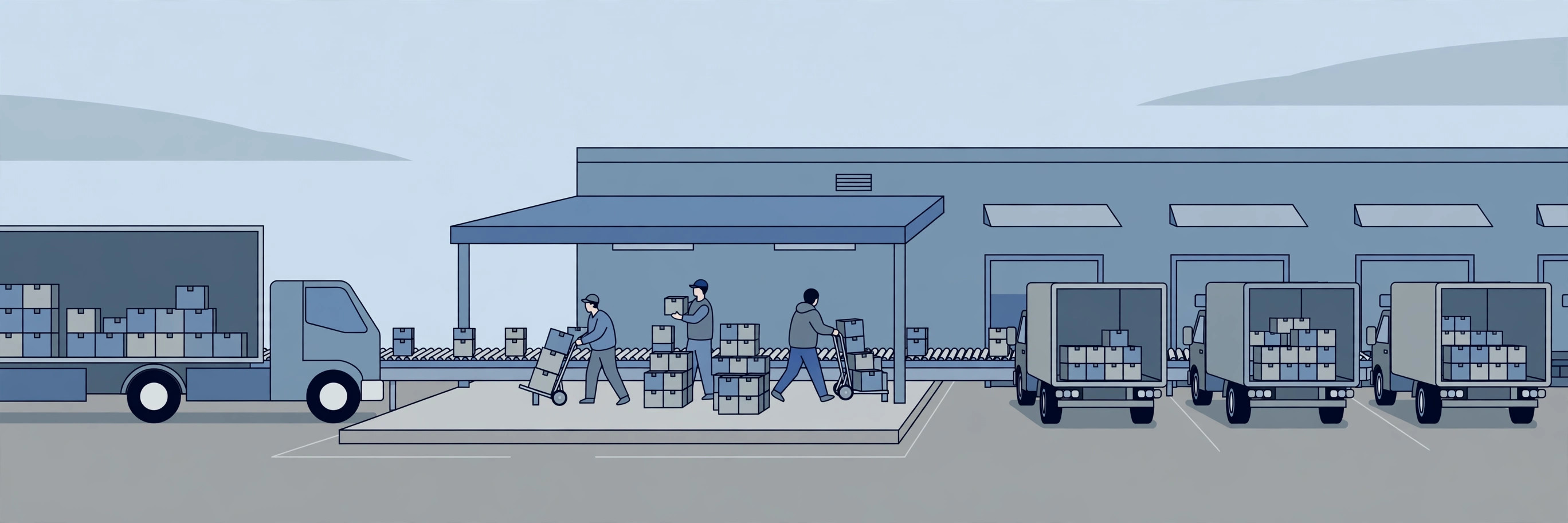
Cross-docking is usually sold as a building: a dock with inbound doors on one side and outbound doors on the other. That picture misleads a retail chain. The building does not decide anything, the shipment does. Cross-docking is a decision, made per shipment, that this freight will not be put away, held, or counted as warehouse stock at all. Get the decision wrong and the dock becomes a very expensive corridor where unallocated stock waits for someone to work out where it belongs. Get it right and the warehouse keeps only the work it is good at: consolidation and shipping, without the inventory-holding function in between.
The flow-through test: five conditions a shipment must pass
Cross-docking, by the definition the logistics sources agree on, eliminates the inventory-holding function of a warehouse while keeping its consolidation and shipping functions, and shipments typically spend less than 24 hours at the facility. A comparison of the two models puts the same line in numbers: cross-docking holds stock for hours, usually under 24, with no inventory held, versus warehousing for days to months, with stock held and counted. That dwell time is the first test, not a hope. Run every candidate shipment through all five conditions:
- Destination is already decided. The goods are pre-sold or pre-allocated, the use the comparison names cross-docking as best for. If nobody can say which store each carton is for, it is warehouse stock, whatever the plan called it.
- Outbound transport is matched to inbound. The model's main risk is delays when inbound and outbound do not match. A flow-through shipment with no outbound leg booked is a putaway shipment arriving early.
- Dwell stays under 24 hours. If the realistic sort-and-ship window is longer than that, the freight is being stored on a dock, which is the worst of both models: no racking, no count, no system home.
- The freight type rewards speed. Cross-docking is especially useful for perishable goods, promotional shipments, and fast-moving SKUs that do not need to sit in a warehouse. Slow, steady lines gain nothing from skipping a shelf they would only occupy briefly anyway, and lose the buffer.
- The sort is simple enough to do once, correctly. On arrival, products are sorted and scanned by destination or order, transferred to outbound vehicles, and shipped to retail locations, with goods on the dock for a few hours or less. If the shipment needs inspection, rework, or price ticketing first, that work belongs in the warehouse flow, not on the dock clock.
A shipment that fails any one condition goes to putaway. That is not a failed cross-dock; it is the test working.
Pre-allocated vs allocate-on-arrival: pick your model before the truck leaves
There are two models, and the difference is when the destination decision is made. In pre-distribution cross-docking, the customer is assigned before the shipment leaves the vendor. In post-distribution, the cross-dock itself allocates material to stores on arrival, the Walmart pattern in the source example. With pre-distribution, goods arriving from the vendor already have a customer assigned, so workers only move the shipment from the inbound trailer to the outbound trailer.
For a multi-store retailer on Business Central and LS Central, that timing choice is the whole design, because it decides what paperwork must exist before receipt. One honesty note: no Business Central or LS Central cross-dock procedure appears in the sourced material, the only Microsoft procedure available is for Dynamics 365 Supply Chain Management, where products are distributed from the receiving location of a purchase order to one or many stores, with system-suggested or manually entered distribution, using location weight with a replenishment hierarchy and a Respect assortments option before quantities are calculated and the order is created. That procedure also explicitly excludes the setup of the replenishment rules, hierarchies, and store weights behind it. Treat it as a contrast, not a template. In Business Central terms, the equivalent discipline is simpler to state: pre-distribution means the store allocation, the transfer orders the freight will leave on, is created before the truck arrives. Allocate-on-arrival means the dock team creates that allocation under time pressure, with the freight already occupying the dock. Default to pre-allocated. Use allocate-on-arrival only for shipments where the store split genuinely cannot be known earlier, and staff the dock for the decision work, not just the moving work.
Run the dock day: receive, sort, and ship without putaway
- Confirm the allocation exists before the inbound arrives. For a pre-distributed shipment, the store split and the outbound documents are ready before receiving starts. No allocation, no cross-dock, receive to putaway instead.
- Receive against the purchase order, not into stock locations. The receipt confirms what arrived; it does not create warehouse inventory to be picked later.
- Sort and scan by destination. Cartons are sorted and scanned by destination or order as they come off the inbound trailer, so a misdirected carton is caught while the trailer is still there.
- Move straight to the outbound vehicle or staging lane per store. The handling is trailer-to-trailer in intent: consolidation and shipping, no holding step in between.
- Ship the store deliveries the same day. The retail replenishment use case in the sources is splitting a container into store deliveries, the dock day ends with those deliveries gone, not staged for tomorrow.
- Sweep the dock at close. Anything left is an exception with a named reason: short shipment, damaged carton, missed outbound. It gets a putaway or a problem ticket that day, not a quiet corner.
What success looks like: the dock is empty of that shipment within the day, every store delivery matches the pre-arrival allocation, and the warehouse stock count never included freight that was only passing through.
What stays in the warehouse on purpose
Core replenishment buffer stock is the deliberate exception. The everyday lines that keep stores trading between vendor deliveries need exactly what cross-docking removes: stock held, counted, and available when a store runs short mid-cycle. Cross-docking that buffer away converts a late truck into an empty shelf, because there is nothing in the building to cover the gap. The same applies to any shipment failing the flow-through test: unallocated freight, freight needing work before it can sell, and freight whose outbound leg is uncertain. A warehouse that holds buffer stock on purpose, and flows the rest through on purpose, is using both models. A warehouse that cross-docks everything is just storing stock badly, on a dock, against a 24-hour clock.
Cross-dock readiness checklist for the next vendor shipment
- Store allocation decided and transfer orders created before the vendor ships, or the allocate-on-arrival model chosen explicitly, with staff assigned to make the split.
- Outbound transport booked to match the inbound arrival, with a plan for the mismatch case, since inbound, outbound delay is the model's main risk.
- Shipment type qualifies: pre-allocated, promotional, perishable, or fast-moving, not core buffer stock.
- No pre-sale work required on the dock: no ticketing, inspection hold, or rework in the flow-through path.
- Dock-day owner named, close-of-day sweep scheduled, and an exception route, putaway or problem ticket, agreed before the first carton lands.
Five yeses: flow it through. Anything else: receive it as warehouse stock and keep the buffer honest.
, Dex Carter, Tech Writer
IndexBack to all guides →