 BC LS Retail Tips
The change log as an integration feed: cheap, honest, and limited
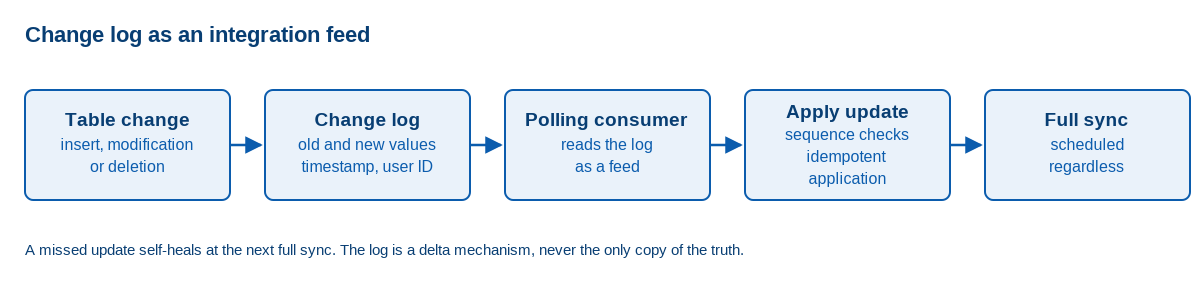
Every Business Central database carries a witness: the change log, recording inserts, modifications, and deletions on the tables you switch it on for, with old and new values. Sooner or later someone integrating a small tool asks the seductive question, can we just read the change log to know what changed? Sometimes, carefully, yes. This article is the careful part.
What the change log genuinely offers
- A complete, ordered record of changes to configured tables, items, prices, customers, with timestamps and user IDs, kept by the system itself rather than by each integration's polling.
- Old and new values, which true event systems often omit, valuable for tools that need to know what a price was, not merely that it changed.
- Zero additional plumbing for the system producing the data: enable logging on the tables, and the record exists.
Where it breaks as a feed
| Limitation | Why it bites |
|---|---|
| It records changes, not meaning | A price "changed" twelve times during a batch edit is twelve log entries and one business event; consumers must debounce and interpret |
| Coverage is configuration | Only tables and change types switched on are logged; an admin narrowing the log silently starves the feed |
| Volume and performance | Logging high-churn tables grows the log fast and adds write cost to every transaction; someone owns pruning, and pruning deletes the feed's history |
| No delivery guarantees | A polling consumer that misses a window (outage longer than the pruning horizon) loses changes with no replay contract |
The decision questions
A change-log feed is defensible when: the consumer is internal and forgiving (a reporting refresh, a search index), the tables are low-churn reference data (items, prices), and a missed update self-heals at the next full sync, which you schedule regardless, because the log feed is a delta mechanism, never the only copy of the truth. It is not defensible for anything financial, customer-facing in real time, or owned by a third party who will build on its silences.
Ordering and the story of a replayed weekend
Feed consumers must survive disorder: messages delayed, duplicated, or delivered out of sequence after an outage. Design the consumption rules for that reality explicitly, sequence checks per entity, "ignore if older than current state" guards for state-style updates, and idempotent application so a replayed message is a no-op rather than a second event. Then rehearse it: once, deliberately replay a weekend's feed at a test consumer and verify the end state matches the source. The rehearsal is the only honest proof, and it converts the recovery from the integration's next real outage, which will arrive during a peak, with the team watching a screen, into a procedure whose outcome is already known. Feeds do not fail in principle; they fail on the third day of a holiday weekend, and they fail exactly at the seams the rehearsal tests.
The audit use is the first use
Whatever else the change log becomes, its original purpose, accountability, remains the reason to run it even if no integration ever reads it. In a retail estate, the change log answers the questions that otherwise become folklore: who changed this price and when, was this item's tax group always wrong or recently edited, did the customer's record get merged or deleted in March. Enable it at least for the money-bearing reference data (prices, posting setup, tender setup, member status fields) and review its volume monthly so the logging scope stays deliberate. Then the integration question can be asked of a healthy, owned dataset rather than of an accidental one, and if the answer is ever "no feed," the log has still paid for itself the first time a price dispute ends with a timestamp instead of an opinion.
Whatever you decide, document the dependency in both places: the integration's notes and the change-log configuration's change control. The failure mode to design against is the quiet one, a well-meaning admin tidying the log settings on a Friday, and a feed going dark without a single error anywhere. Success: a shortcut taken with its limits written down, a full sync behind it, and an owner who knows the feed exists.
, Dex Carter, Tech Writer